• Skip to main content

JPNicols.com

Helping leaders make better decisions when the status quo feels safest

  • About
  • The Irrelevance Trap
  • Insights
  • Speaking
  • Contact

Blog

Your Fast Follower Strategy is Riskier Than You Realize

In my last post Leaders, Learners and Laggards I talked of banking leaders who describe their approach to innovation as being a “fast follower, and how my typical retort is that they are half-right— most of them are definitely followers, but there usually isn’t anything fast about their approach.

This has spurred some great discussions on social media, including some comments from people who defended the fast follower approach as a sound strategy. So it appears some clarification is needed on my overarching point.

A fast follower approach in terms of making big public bets on new products is absolutely a proven strategy.

A Great Strategy When Well Executed

Apple is often cited as one of the world’s most innovative companies, but they are not known as a bleeding edge pioneer of new technologies. The Apple computer was not the first personal computer, the iPod was not the first digital music player, and the iPad was not the first tablet computer.The iPhone was not the first smartphone, but it controls 92% of the profits of the global smartphone market.

The Apple Watch is not the first smart watch either, as any Android fan will be quick to point out, but within the first quarter of its release it reduced Samsung’s global market share of smart watches from 74% down to 8%.

Within the first quarter of its release.

Within one year Apple became the second largest watch manufacturer in the world. (For way more detail on how Apple, Amazon, Google and Facebook are taking over the world, watch Scott Galloway’s breathless take from the DLD conference.)

The ‘first mover advantage’ theory established in the early days of high tech in the 1980s was pretty much dismantled by Peter Golder and Gerard Tellis at USC in 1993. They found the almost half of product pioneers failed, and even those that didn’t fail had lower average market share than later market entrants. Countless stories abound today of product pioneers being quickly supplanted by upstart rivals.

The Fast Follower strategy is viable, but the operative word is fast. At least in relative terms.

And that is what is missing from most financial institutions, who measure speed by the decade.

Where’s My Jetpack?

As a child of the 1960s, I was promised a jetpack and vacations on the moon. Those were scaled back to a hoverboard and a time-traveling DeLorean in the 1980s, but the future destination of Back to the Future has come and gone with no such improvements in my daily life.

maxresdefault

But I do carry around in my pocket every day a the equivalent of a 1970s supercomputer, I regularly video chat with friends and colleagues all over the world on it, and I can now summon my self-driving car from my watch.

The Gartner Hype Curve is a useful construct to visualize how exaggerated expectations come down to earth in the short run. Some ideas die off, and others are iterated upon and adapted, and their lifespan is extended. Sometimes the passage of time can also help the market catch up to those that were initially ahead of their time.

Fast Follower - Hype Curve - JP Nicols


Ideas don’t exist in a vacuum, they catch on (or not) in a society of humans through a fairly predictable pattern that Everett Rogers called the Diffusion of Innovation curve.

This bell curve shows how early or late segments of the population adopt new ideas. Innovators flock to new ideas, followed quickly by the Early Adopters. Over time some of these ideas are picked up by the Early Majority, followed by the Late Majority, and eventually even the Laggards.

Fast Follower - Adoption Curve - JP Nicols

Trailblazers, Traditionalists, and the Chasm Between

In 1993 Geoffrey Moore introduced to Rogers’ curve the concept of the ‘chasm’ that exists between the Innovators and Early Adopters and the rest of the segments on the curve. Left of the chasm, people live to explore new ideas, and they are willing to take a reasonable amount of risk in order to reap the benefits of being early. They are the first buyers of new products, the ones waiting in line overnight for the pride of owning version 1.0.

Right of the chasm is where phrases like “Nobody ever got fired for hiring IBM” come from. They want to take zero to very little risk, and they are willing to accept a relatively limited upside in exchange for this reduced risk.

These two broad groups— the left and right sides of the chasm— align closely with the groups I have highlighted before as Trailblazers and Traditionalists. Trailblazers want to explore the unknown and establish next practices, while Traditionalists want to master the known knowns and enforce best practices.

The picture becomes even clearer when you plot the two curves together. Ideas must cross the chasm to have commercial viability.

Fast Follower - Curve Mashup - JP Nicols

This highlights the challenges of truly being fast when you’re a follower.

The kinds of companies full of Trailblazers that come up with groundbreaking new ideas often do not have the very different skills of scaling up those ideas for mass market adoption. This goes a long way to explain why the first movers often fail to maintain commanding market share over the long run.

Likewise, mature organizations in mature industries full of Traditionalist employees, like, say, financial institutions, often don’t have the skills (or inclination) to develop and incubate new ideas. Hence the launch of new bank innovation teams and labs in recent years.

The Key to the Fast Follower Approach

The danger is in waiting too long so that the new idea— once groundbreaking and with the potential to set your institution apart from the pack— is now mainstream.

Before long, mainstream becomes table stakes. The longer you wait, the wider becomes the customer experience gap— the gap between what your customers have come to expect as a minimum, and what you actually provide them.

As Innosight’s Scott Anthony puts it in Harvard Business Review:

“But make sure that when you say that you want to be a fast follower you aren’t really saying, “Can’t I just go back to running my core business?” Too often people find that when it is a strategic imperative to respond, it is too late.”

So a fast follower approach can be a wise one, providing you’re actually fast enough to capture an idea on the upside of a growth curve.

Otherwise, it’s a riskier strategy than you realize.


Filed Under: Archive

Leaders, Learners and Laggards

Leaders Cover

I talk with a lot of banking leaders who describe their approach to innovation as being a “fast follower. My typical retort is that they are half-right— most of them are definitely followers, but there usually isn’t anything fast about their approach.

Pioneers are the ones who get hit with arrows, and it is only natural that bank executives who are (quite appropriately) concerned with avoiding and managing risk as a large part of their job duties don’t want to be out on the bleeding edge of innovation.

New ideas are unproven, while existing products generate today’s earnings from existing customers. The idea of diverting precious limited resources and managerial attention toward unproven ideas makes prudent managers understandably uneasy.

The risk of not taking risk

Today more than ever, though, leaders should also be concerned about the risk of not taking risk.

The risk of not taking risk is much harder to identify and manage. It’s the risk of not investing in new ideas that can keep the company competitive, or even leapfrog the competition or create new products or markets.

While the payoffs can be huge, this is not a risk-free investment.

Not all new ideas will pay off. Some will be be total failures, and this is a hard reality to accept for managers who spent their careers making safer bets and avoiding losses. That’s the core operating model of banking, where nearly 99% of loans made are expected to be repaid in full with no loss.

A Fixed Income Investment Approach

Traditional retail and commercial bankers are not venture capitalists, where five total losses and four break-evens in ten investments is simply the price to be paid for a shot at the one homerun that pays off all of the other bets and then some.

Bankers are more like fixed income investors, where the best outcome is a return of principal, plus a single digit interest rate spread on the principal.

The formula for winning that game is taking a large amount of relatively safe bets, with a pretty high confidence level that the risks involved are well known and quantified.

And so has gone the approach of most bankers, not only for their loan portfolios, but by extension their very business models, for literally centuries. This approach works well when the competitors are all similar and all are playing the same game by the same rules.

However, when new disruptive forces shake up the status quo, and new competitors this approach carries hidden risks.

Like the risk of not taking risk.

Enter the S Curve

S Curve

Most businesses have S Curve growth cycles— a flattish early period during the business’s launch and early adoption, followed by a period of steeper growth which eventually declines as the business matures. If new products, customers or markets cannot be harnessed to jump to the next S curve, the business will die out.

How do they ‘jump the S-Curve’, as Paul Nunes and Tim Breen put it in their book Jumping the S-Curve: How to Beat the Growth Cycle, Get on Top, and Stay There? I think this is an especially troubling question for banking leaders.

This is a new phenomenon for banks, whose fixed-income investment approach to management has led to a more stable (and lower) growth trajectory, once adjusted for economic and interest rate cyclicality. In other words, what has historically caused variability in bank earnings has been changes in interest rates and economic conditions (and therefore loan losses and reserves), rather than major competitive shifts in the marketplace.

Until now.

The rise of new competitors and new business models in financial services are forcing bankers to confront the S curve for the first time. Companies who thrive in dynamic industries are used to using innovation to effectively transition from one curve from the next.

Innovation is all about creating new options, and this is becoming increasingly important in banking.

Leaders, Learners and Laggards in Innovation

Leaders, Learners graphic

I have talked and written before about Leaders, Learners and Laggards in innovation.

There are just a handful of banks we could consider leaders in innovation. Leaders deeply understand the need to innovate and they prioritize ongoing innovation as a business activity just as necessary as compliance and asset-liability management. Senior leadership, from the CEO on down, require and reward innovative thinking, and they set a growth agenda for the company that puts emphasis on generating new sources of revenue. They try to disrupt themselves before someone else does it for them.

But Leaders don’t just rely on top-down strategies to improve and expand their business, they also encourage and invest in bottom-up innovation. Likewise, they supplement their internal innovation efforts with external involvement and investments in incubators, accelerators, hackathons, venture capital, and lots of other ways to engage in and help develop the broader ecosystem. Innovation is a 360 degree activity for Leaders.

A slightly larger, and growing, group of Learners have just begun to realize the need to innovate. Learners may even have pockets of innovation within the company currently, but they haven’t really embraced innovation as a business necessity. Early Learners may be infected by FOMO, the fear of missing out that arises from seeing others’ success, and they may be tempted to make token gestures to drive appearances rather than actual results.

Early Learners may also think that merely adding the word ‘innovation’ to someone’s job description is a major accomplishment. If they are truly committed to learning though, they will discover that ongoing attention and support is needed to get business results from innovation. Later stage Learners start to realize the benefits of their efforts, and start to make additional investments to accelerate results.

Unfortunately, there is still a long tail of Laggards, the institutions that still don’t even know why they should innovate. Laggards still have tunnel vision on the way things used to be, so they can’t even see the changes happening all around them. They are convinced that success is just about perfecting their existing products and services, and they very narrowly define their competition as just their peer group of similar institutions.

Moment of Truth for Laggards

As the release of loan-loss reserves is no longer fueling bank earnings, and interest rates and loan spreads remain low, banks must innovate new revenue sources and new ways of delivering customer value. The gap between the laggards and the learners and leaders will only expand, and many laggards will be acquired by faster moving institutions.

Many laggards are simply unable to sense the shifting landscape, while others have willfully disdained what they perceived to be the riskier path of trying new things.  The true cost of their inaction and ignorance will be borne out in the coming months and years.

As Warren Buffett says, “Only when the tide goes out do you discover who’s been swimming naked”.

Filed Under: Archive

The Four People Who Ruin Innovation

four-people

Innovation is fun. Except when these types are around. How many do you know?

The Hypemaster 

Hypemaster

The Hypemaster is, well… a master of hype. Everything they’re working on is amazing, and you must absolutely drop everything and check it out. Right now! “Hey we’re getting ready to launch Hypemaster.io, check it out and let me know what you think!”

I love meeting new people and seeing new ideas, even though I usually don’t have a lot of free time to look at a stranger’s project and give them a bunch of free advice. But I try to be helpful, so sometimes I do it, if the approach is right.

The Hypemaster doesn’t respect your time or your own commitments, and they really don’t even want your advice anyway. They just want you to promote their link on social media, or worse, ruin your friendships by introducing them to other people. Their project descriptions are stuffed with enough buzzwords to make Dilbert’s pointy headed boss jealous. “We are radically disrupting this vertical with a full stack digitized approach to the blockchain, with fully-configurable architecture and a lightweight contextualized interface”.

Natural Habitat: Startup Conferences, Conference Apps, Twitter DMs, LinkedIn InMails


The Innovation Snob

Innovation Snob

Nothing is cutting edge enough for the innovation snob. 3D Virtual Reality? Yawn. It’s been done already. Self-driving car? The Innovation Snobs claims to have been into them 10 years ago, but it’s too mainstream for them to bother with now. They think Elon Musk’s rockets are too similar to what NASA did in the 1960’s.

Continuous improvement and incremental innovation are an important part of keeping a company growing, but they are nothing but eye-rolling material for the Innovation Snob. Solving real problems that paying customers care about is the true heart of innovation, but the Innovation Snob only wants to see something they have never seen before. Preferably on a touchable hologram emanating from a smartphone that hasn’t been released yet.

They also think they are the only ones entitled to an opinion. Everyone else is a pundit, armchair quarterback or wannabe, they’re the real deal, damn it.

Natural Habitat: The Bar after the Conference, Finovate Twitter Feed, Facebook Comments.


The Disruption Denier

Disruption Denier

The Disruption Denier is the 180-degree polar opposite of the Hypemaster. NOTHING is impressive or impactful to them. All of the good ideas are already taken. Anyone with a new idea is simply a charlatan trying to separate you from your hard-earned money. They’ve been there, done it, got the T-shirt, and knew better the whole time. They also know far better than than you now that your new idea will never work. They’ve tried it before. Didn’t work then, won’t work now.

Disruption Deniers think they alone have figured out how the world really works, and that the current state of affairs is permanent and unchangeable. Worse, they sometimes are even convinced that some previous era was actually the ideal situation, and that most progress made since then is regrettable.

Sometimes this perspective comes from a comfortable perch built from doing something that did indeed work just fine in the past. Usually though, it really just comes from a dark and bitter place where they just don’t want to accept their own failures, so it makes them feel better to lash out at others, usually through drive-by assaults in the comments section.

Natural Habitat: Mid-Level Management, Golf Courses, LinkedIn Group Comments on Others’ Posts


The Chameleon

Chameleon

This person can be hard to spot. They might seem at first to be a Hypemaster, singing the praises of the hottest piece of technology, especially if it isn’t exactly brand new. At other times, they may appear to be a Disruption Denier, clucking at some previous market darling’s fall from grace. They gyrate wildly from pro to con, and from fanatic to critic.

They were the first to tell you how excited they were about the Apple watch when it was announced;  but now that their friend is less than enamored, they tell everyone how much it sucks. All through secondhand knowledge, because they won’t buy their own until Version 5 comes out.

The chameleon has an incredible ability to blend in to its immediate surroundings; sensing the environment around him and adapting to it quickly and without notice. Apparently the price for this superpower is a lack of original thought and reasoning ability. They do, however, possess 20/20 hindsight.

Natural Habitat: Company Lunchrooms, Cable News, Facebook, Twitter (main feed)

Everyone around you is either helping you get to where you are trying to go, or they are not. These people definitely are not. You can’t always pick your boss, your coworkers, or a lot of the other people you come across daily, but your innovation efforts will improve if you get rid of these people.

And you’ll have a lot more fun.


Filed Under: Bank Innovation, FinTech, Leadership, Miscellany

Top Five Posts from JP Nicols in 2015

Top 5 1000x571-2


Thanks to everyone who read, engaged, commented and shared my posts over the past year. I am proud to be a part of a great and growing global community that is committed to improving financial services for the better. Here’s to a great 2016!

Follow me on Twitter:

Follow @JPNicols


Learn more about me:

About JP Nicols


Here are my five most popular posts from 2015:

Big Data and Alternative Payments Top Capital One Fintech Survey

CapOne Survey 1000x571


It’s Too Late, Banking Is Already Being Disrupted

Too Late 1000x571-2


In Search of Competitive Advantage

Comp Advantage 1000x571-2


Innovation is More than the Next Big Idea

Big Idea 1000x571-2


Traditionalists vs. Trailblazers in Innovation

T&T 100x571-2


Filed Under: Bank Innovation, FinTech, Leadership, Miscellany

5 New Years Resolutions for Bank Innovators

Resolutions 1000x571-2


Here are some New Year resolutions for the growing group of bankers who are adding “innovation” to their do-to list in 2016. Getting these right will greatly improve your chances for success in the new year.

1) Define Your Innovation Goals

So, what do you want to get out of your innovation program?

  • Incremental improvements or radical disruption?
  • Catching up to competitors or breaking new ground?
  • Renewing existing capabilities or creating new ones?
  • Updating your offerings or launching new products?
  • Pushing more ideas from the top down or bubbling more from the bottom up?
  • A focused challenge or a broader initiative across business lines?

Define your innovation goals and align your team and your priorities accordingly.

2) Take Your Innovation Program Seriously…

Hopefully you are doing this because you recognize that the world is changing, and that companies in every industry have to change and adapt with it– to retain your current customers, to acquire new ones, to generate new revenues, to stay relevant.

Innovation shouldn’t be the flavor of the month, or something that someone from your executive committee wrote down at the “strategic offsite” as a box to check off for the next board meeting. It should be part of the way you do business. Part of your DNA.

Put the right people in charge. This isn’t the place to park your retiring executive or the place to create some resumé padding for your up and comers. Find the smart and curious people who challenge the status quo. Get some outside help. There’s a pretty good chance that starting an innovation program is significantly different than anything you have managed before, and many of the instincts and experiences that have led to your current successes might actually get in the way.

3) …But Not Too Seriously

Create a sandbox where people are free to experiment and test and try new things. Don’t force your normal ROI metrics on an innovation project that is really unique, disruptive or conceptual. If you do, you’ll end up watering it down to something much more incremental. That might be OK, but you also might miss out on something that could really differentiate you from your competitors.

Truly transformational ideas take a while to build and test and get traction, don’t throw all of your resources into one massive project. Start with some smaller projects where you don’t have to be afraid of making mistakes.

4) Focus on Learning

Get out of the office and learn from what others are doing. Meet entrepreneurs who are coming up with new solutions that you might be able to use– many of them want to partner. Look at new ideas from different industries and think about how they might be applied. Read more!

We have a tendency in the banking industry to develop new ideas inside our own four walls, validated only by our own people, inside our own echo chambers.

5) Focus on the Customer

Innovation isn’t necessarily about cool technology. The most successful ideas are those that solve a real pain point or create an important gain for a customer.

Don’t be afraid to get customers involved early. Talk to them. Even better, watch what they do. What work-arounds have they created to fill gaps between existing offerings? What products or services are they using from your competitors?

Focus your innovation efforts on things that matter to your customers.


Filed Under: Bank Innovation, FinTech, Leadership

JP Nicols to Guest Host Breaking Banks


JP Nicols, Co-Host-2

I am pleased to announce that I will now be a recurring guest host of Breaking Banks, the only dedicated radio show and global podcast focused on disruption in Financial Services and the emerging FinTech sector.

As you might expect, I will be especially focused on how banks are innovating in today’s rapidly changing world, but I’ll be covering other topics in fintech and financial services too.

Listen to the show live at 3:00ET on WVNJ 1160AM in NYC and on the VoiceAmerica Business Channel, or download the podcast on iTunes, Stitcher or Soundcloud. 

My first episode aired on December 10, where my guests included Scarlett Sieber from BBVA, Jaidev Shergill from Capital One Growth Ventures, and John Schulte from MercBank as we discussed Innovation from the Inside.

Breaking Banks is exploring how banking is rapidly being disrupted and how context and digital are becoming the new drivers of banking experiences. The FinTech space is one of the world’s fastest growing sectors today with estimates for more than $20 billion of capital being invested in the space in 2015.

Traditional banking is being challenged right to the core and the next 10 years will see more changes in banking than in the last 100 years. Breaking Banks is documenting those changes and exploring the best of the best in FinTech globally.

About Breaking Banks

Breaking Banks broadcasts/streams live every Thursday at 3pm Eastern (12 noon Pacific) in the US on AM 1160 WVNJ Radio (New Jersey, New York and Connecticut) and via Voice America’s Business Channel.

A truly international radio show with more than 1.2 million listeners from 72 countries, it is the fastest growing show on VoiceAmerica World Talk Radio and it consistently ranks in the top 3 Business Channel shows.

breakingbanks.com

Filed Under: Bank Innovation, FinTech

Big Data, Alt Payments Top Fintech Predictions


CapOne Survey 1000x571

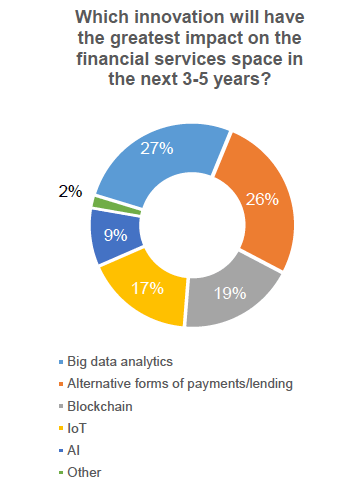
Capital One has released a survey of 151 fintech and payments innovators which they conduced at Money 20/20 a couple of weeks ago.

Given this non-random sample of participants, it is probably not surprising that Big Data Analytics and Alternative Payments Platforms were the top two answers (at 27% and 26%, respectively) to the question “Which technology innovation will most impact financial services in the next 3-5 years?”.

The only surprising to me about the number three answer was how “blockchain”, only came in with 19% of the vote. It’s been at the top of the hype curve over the last few months, as I reported from Sibos.


Capital One Fintech predictions

The survey also asked for some predictions about finance in the year 2030.

At the top of this list was the prediction that the majority of payments in 2030 will be cashless, non-paper based (56% of respondents), and that Social media shopping will account for nearly half of holiday sales transactions by 2020 (22%).

Capital One 2030 Predictions

If these predictions are accurate the customer experience gap that banks have with their customers today is only going to get wider. Sounds like a good time to get to work on innovating some new products and new customer experiences.

The survey also has questions on the future of data security and fraud prevention.

Here’s a short video with highlights from the survey results from Capital One, which partnered with me to provide data for this post:


http://jpnicols.com/wp-content/uploads/2015/11/CapOne_20-20_Survey_ALT_v02.mp4

Join the discussion on Twitter with @CapitalOneLabs and with the hashtag #BankOnTech. More information is available at press.capitalone.com.


Filed Under: Bank Innovation, FinTech, Practice Management

Why Collaboration Matters in Banking

Collaboration Matters 1000x571-2


I spent most of this week at Money 20/20 in Las Vegas. The show continues to grow— 10,000+ attendees this year— and it continues to be a magnet for banking and payment executives, merchants, fintech entrepreneurs, investors, analysts and plenty of commentariat on all such things.

With more than 550 (!) speakers at Money 20/20, the content was uneven, as one might expect. For every thought-provoking keynote like that of Patrick Collison, CEO & Co-Founder of Stripe, there were plenty of ho-hum recitations of corporate press releases.

“Most People are building cars (FinTech products). We are building Roads.”

– Patrick Collison, via Sam Maule 

And, for every standing-room only panel session like this one, there were droves of drones, droning on.

Standing room only with future of payments panel with Facebook, PayPal, Western Union, AliPay, Vantiv #money2020 pic.twitter.com/D0GYjbecSs

— Bradley Leimer (@leimer) October 26, 2015

CSQ4UXpUEAAiwB_


Merchant and Issuer Collaboration

Following Capital One, Chase announced its own mobile wallet app. Chase’s announcement marks their efforts to build an early bridge between the deeply divided camps of merchants and card issuers with the mobile payment solution Chase Pay.

Chase Pay, which will work on “virtually all phones”, enjoys the backing of the merchant consortium MCX, which includes some of the largest retailers in the world, including Walmart, Target and Best Buy, but most early assessments are less than enthusiastic about the customer experience, centered around QR codes. We’ll keep an eye on that, but it does bring one of the largest credit card issuers and payment processors in line with a huge number of merchant customers, and it was hard for me to see how MCX’s CurrentC was going to get traction with consumers.

Collaboration at All Hours

But great conversations were happening everywhere, and not just on stage — in the hallways, in the restaurants and bars, at the casino tables, at private meetings, and at the parties. At Money 20/20, there are always the parties…

Money 20/20 is where kids who were home-bound homework-slaving nerds go to feel like the cast of Entourage.

“Hey, are you going to the Wyclef Jean party at the Tao Beach Pool?”


“Right now I’ve got to drive some Ferraris and Lamborghinis around, and then I have a dinner at the Eiffel Tower restaurant, but I’ll try to swing by later if I can.”

Wyclef Jean at #money2020. Because Conference. pic.twitter.com/BK08H94dpA

— Julie Schicktanz (@JulieSchicktanz)  October 27, 2015

CSTHbWiUYAA1vQw


Had an amazing event last night with @MXenabled. Everyone was able to drive Ferrari’s and Lamborghini’s. #Money2020 pic.twitter.com/3Lify426aa
— Matt West ️ (@Matt__West)  October 27, 2015


CSVs12vUYAAds40


Bank and Fintech Collaboration

As usual though, I spent most of my time looking at how financial institutions are innovating and how they are collaborating with fintechs to innovate. John Waupsh, Chief Innovation Officer at Kasasa by BancVue captured a great quote by Marc Lien, Director of Innovation & Digital Development at Lloyds Banking Group:


#money2020 – Lloyds: “Winning fintechs will realize that to scale, they need to partner w/ banks & winning banks will partner w FinTech”


— John Waupsh (@waupsh)  October 28, 2015

Lien was speaking on a panel which also included Phil Gilligan, Managing Director, Head of GTO Innovation at Deutsche Bank and Niki Manby, Chief Operating Officer at Citi Ventures. The panel was moderated by Chris Skinner and was titled Responding to Disruption: Are Banks Meeting the Challenge of New Competitors & Changing Customer Expectations?

As anyone who has read or heard me before knows, my answer to the rhetorical question posed in the Title is “Only a few”.

Leaders, Learners and Laggards

We continue to see a power curve distribution in the industry of Leaders, Learners and Laggards. Most are laggards. They think that innovation is for someone else, and they are smart by being “fast followers”. It might be smart, if they put more emphasis on “fast” instead of “follower”.

There is a small and growing group of learners— those that know they need to innovate, and have pockets of innovation, but also know they need to do more.

Only a relatively few financial institutions worldwide can be seen as leaders in innovation. These are those organizations that have both broad and deep innovation efforts, from the incremental to the radical, and they seek to embed innovation throughout the organization. They also connect and collaborate across a broad ecosystem that includes customers, vendors, partners and even potential competitors.


Leaders, Learners graphic


Collaboration at Capital One

One of the innovative financial institutions I have long admired is Capital One. From the company’s philosophy that it is a data company that just happens to be in the banking business, to the work of their three internal innovation labs, to their acquisition of design studio Adaptive Path and the hiring of Daniel Makoski from Google as its first Vice President of design, the company has a knack for being a leader, not a follower.

So I was happy to spend some time this week working in partnership with Capital One Growth Ventures, the company’s one-year old corporate venture capital arm.

On Tuesday afternoon I moderated a panel discussion with Jaidev Shergill and Lauren Connolley from their team. Both Jaidev and Lauren are ex-bankers turned entrepreneurs turned VCs, so they have a broad perspective on the fintech space.

Startups Need Relationships and Contacts

We talked about the unique value a corporate venture capital firm can provide to startups as a strategic investor, as opposed to a pure financial investor. Shergill pointed to the firm’s recent survey of tech entrepreneurs which showed that the top two things they were looking for from their investors were commercial relationships (69.5%) and useful connections (61.4%).

That’s easy for me to believe. I know from first hand experience as an advisor to early stage companies that it’s difficult to sell to banks. Startups can create products from scratch faster than most banks can assemble a meeting of the various constituents.

I asked Connolley if Capital One needed to be a lead customer for their investments, or if they were OK with the companies selling to other banks too. Her response:

“Sometimes we are customer number one, sometimes we are customer number two or three or ten. As long as we all have appropriate privacy measures in place, we’re fine with that. We are especially interested in companies that build platforms that can be used in multiple ways”.

Lauren Connolley, Capital One Growth Ventures

Shergill also talked about his group’s ability to add value from the early stages of product/market fit to later challenges of testing and validating new use cases and achieving scale rapidly. He pointed to their investment in Chain Inc., a startup that builds and deploys blockchain networks to facilitate seamless transfer of digital assets.

“We provide a really unique opportunity to test innovative technologies, and we can connect the companies we invest in to people in multiple business lines to test any number of use cases”

Jaidev Shergill, Capital One Growth Ventures

It’s one thing to add a feature to your existing products and call it innovation, it’s quite another to be willing to disrupt yourself and even invest in the disruptors.

You can learn more about Capital One Growth Ventures at growthventures.capitalone.com, or contact them by email at COFventures@capitalone.com. The firm focuses primarily in the areas of Big Data Technologies, Payments & Commerce, Security & Authentication, and Small Business.

*Thanks to Capital One for sponsoring portions of this post, but all opinions expressed are mine, all mine.


Filed Under: Bank Innovation, FinTech, Leadership

  • « Go to Previous Page
  • Page 1
  • Page 2
  • Page 3
  • Page 4
  • Page 5
  • Page 6
  • Interim pages omitted …
  • Page 18
  • Go to Next Page »
  • Contact
  • Speaker One-Sheet
  • Media Kit
  • Podcast
  • LinkedIn
  • YouTube
  • Alloy Labs

Copyright © 2026 · Infinity Pro on Genesis Framework · WordPress · Log in


Loading Comments...